When I arrived in India I thought it was only right to pay my respects at Bhabaur Sahib where it is likely that the Dasam Granth was bound when the Charitropakhyan Sahib was completed.
Gurdwara Bhabaur Sahib where the Charitropakhyan was completed with the Chaupai Sahib
Close up to the board which gives the Colophon from the Dasam Granth Sahib.
After this point I visited Baba Surjit Singh in Patiala and presented him a copy of the book.
A number of years ago Sant Parmjit Singh of the Sant Samaj asked me to write book in Punjabi and he would add to it, but unfortunately he passed away. So instead I gave a copy to his brother Soami Harnam Singh ji, pictured below. The task of writing the book into Punjabi has now been taken up by the Buddha Dal. Copies of the book were also give to Sant Baba Gian Singh pictured further below, Dr Baljinder Kaur of Bhasha Vibhag, Dr Rupinder Singh, as well as many other scholars.
Sant Parmjit Singh who is sadly missed by the Sangat.
Sant Baba Giana Singh student of Buddha Dal and Dam Dami Taksal. A master of Sikh scripture and sword. At 105 years old he is doing very well. He even went to jail with Mahatma Gandhi!
After presenting the book to Dr Baljinder Kaur of Bhasha Vibhag, she kindly presented us a copy of her book.
Ranjit Singh Advocate saying some kind words about my research.
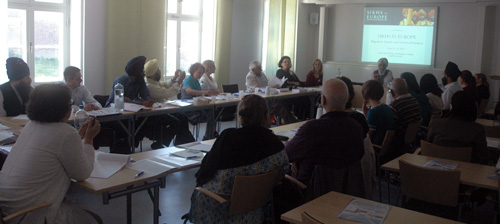
An Exploratory Workshop on "The Sikhs in Europe. History, Religion and Representation" was held at Lund University, 13-14 June 2008. The conference was funded by the Bank of Sweden Tercentenary Foundation, the Swedish Research Council, the Swedish Council for Working Life and Social Research and the Wenner-Gren Foundation. The invited speakers included Prof. Shinder Thandi from Coventry University, UK, who talked about "Migration and History of the Sikhs in Europe"; and Prof. David Omissi, University of Hull, UK, who talked about "Indian Soldiers in Europe, 1914-1918". The entire workshop was public. On the second day, discussions were held regarding possibilities for future European collaborative research projects on Sikhs in Europe. More information.
At the end of the workshop, the participants decided to establish the network Sikhs-in-Europe for the purpose of developing closer academic cooperation between students and researchers with a common interest in the Sikhs and Sikhism in Europe.
The creation of the network Sikh-in-Europe reflects a growing academic interest in the European Sikh and Punjabi diasporas. An extensive migration from the Punjab – the north-western state of India and the “ homeland" of the Sikhs - in the twentieth century resulted in Sikh settlements in different parts of the world. This development attracted the scholarly attention to the Sikh religion and Sikh diasporas, especially in English-speaking countries. New patterns of migration, settlements, representations and transnational networks of the Sikhs in more recent decades have made scholars aware of the importance to undertake research studies of the Sikhs in different European contexts and the need to create academic collaborations across disciplinary and national borders. As the first step in this direction, the network Sikhs-in-Europe is an initiative to create cooperation between scholars who come from a wide range of disciplines and are affiliated to different universities in Europe and beyond. In July 2008, a new web site was established by the network, titled Sikhs-in-Europe It contains a lot of useful information about conferences etc. Go to the web site.
A full-scale three-day conference on "Sikhs in Europe. Migration, Identity and Translocal Practices" was then held at Lund University, 16–18 June 2010. The aim was to gather leading scholars in the multidisciplinary field of Sikh studies and discuss current research projects focusing on patterns of migration, identity formations, self-representations, transmission of traditions and trans-local practices among Sikhs in different parts of Europe.
While two conference days were dedicated to presentation and peer-review of papers by the members of the academic network Sikhs-in-Europe, the third conference day was a workshop for Ph.D. students affiliated to European universities, organised by Dr. Laura Hirvi, University of Jyväskylä, Finland.
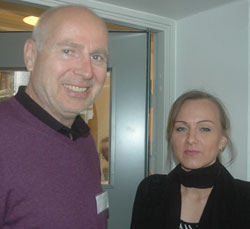
Knut and KristinaGurinder S MannThe conference was again convened by Dr. Kristina Myrvold, Lund University. Here seen with Prof. Knut Jacobsen, University of Bergen (photo to the right).
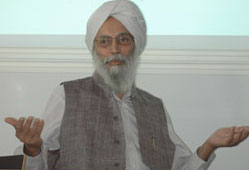
The keynote lecture on 16 June was given by Prof. Gurinder Singh Mann, Centre for Sikh and Punjabi Studies, University of Californa at Santa Barbara, USA (photo to the left). He spoke about "Guru Nanak and the Sikh Religion: Some Reflections", and focused on the classic 1968 monograph "Guru Nanak and the Sikh Religion" by Prof. W H McLeod, University of Otago, New Zealand.
Other participants to the conference included Dr. Doris Jakobsh, University of Waterloo, Ontario, who gave a SASNET lecture in 2004 on "Sikhs, Colonization, Gender and Ritual" (more information); Prof. Eleanor Nesbitt, University of Warwick, Coventry, UK (also Reviews Editor for the Journal of Punjab Studies); and PhD candidate Kathryn Dominique Lum, who completed Lund University’s Masters programme in Asian Studies in 2007, and is now based at the European University Institute in San Domenico di Fiesole, Italy, working on a doctoral dissertation project related to the Ravidassia Community and Identity(ies) in Catalonia, Spain (more information).
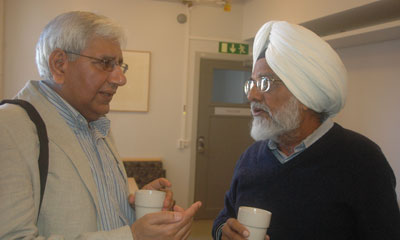
Participants at the 2010 conference in Lund: Shinder Thandi, Coventry University, UK; and Swarn Singh Kahlon, independent researcher from Chandigarh, India. Other participants: Kaveri Harriss, University of Sussex, UK; and Kamalroop Singh, University of Birmingham, UK
Conference report: Sikhs in Europe 2010
Written by Administrator
The first report of the conference "Sikhs in Europe: Migration, Identity and Translocal Practices" that was held at the Centre for Theology and Religious Studies, Lund University, on June 16 to 18 is now available at the Swedish South Asian Studies Network (SASNET).
Sikhs-in Europe is an independent and interdisciplinary academic network for students, teachers and scholars conducting studies of and research in all areas related to the Sikh history, religion and culture in Europe. The forum was created in 2008 and is managed by a collaborative group of scholars from different European universities.
The aims of the network are:
To promote and establish academic cooperation and exchange between students, teachers and scholars from various disciplines who share the interest in Sikh Studies.
To assist students and scholars by facilitating access to information about research projects and publications on the Sikhs in Europe.
To provide updated information about academic events and activities related to the Sikh Diasporas.
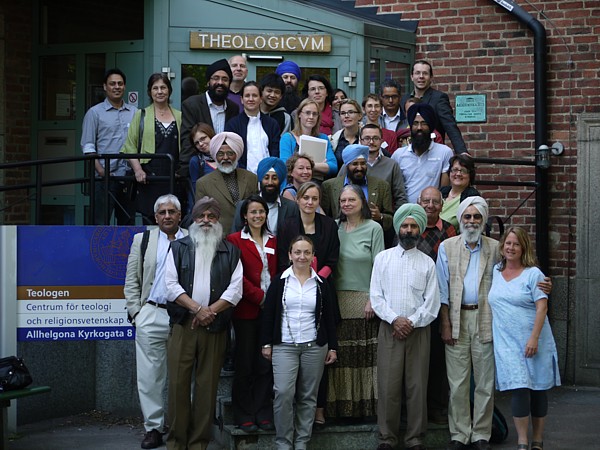
Participants of the conference "Sikhs in Europe: Migration, Identity and Translocal Practices" held at Lund University on June 16 to 18, 2010.
ESA RN 34 – Midterm Conference 3.-5. Sept. 2012, List of Thematic Sessions 12-07-2012
Negotiations of Religious Practices & Identity Formation in Migrant Contexts I
Kamalroop SINGH
The Turban – The Impact of 9/11 on Sikh Identity
After the terrorist
attacks of 9/11 there was a media frenzy of showing turban wearing Taliban.
This depiction caused a rapid polarization in the perception about overt
religious practices. A visible identification of male Sikhs, and sometimes
females, is their Dastar or Turban. The Turban has been worn by different people around the world for many
thousands of years, but for the Sikh community it carries a deeply religious
significance. For initiated Khalsa Sikhs they are required to wear a turban as
a religious obligation. As a result of this perception some turban-Sikhs have
been victims of racial violence and had their identity challenged by calls to
assimilate into Western societies.
A
major problem has been at airports where sometimes security personnel have
requested Sikhs to remove their turban. This is problematic for Sikhs as they refrain
from cutting their hair and wear turbans, which are not to be removed in
public, which would be considered highly undignified for a Khalsa Sikh, as the Sikh turban is not considered by them to be
like a hat. In Europe the Sikhs have faced a number of challenges, firstly back
in the 1970s in the famous Mandala case victory, that allowed Sikhs to go to
school wearing the turban, however, this is now an issue in French schools.
This
paper seeks the address the history of the Sikh turban in Europe, with the
major focus being post 9/11. In addition, the injunctions regarding the turban
from historical ‘Sikh codes of conduct’ or ‘rahitnāme,’ will be
discussed. The paper will conclude with an examination of how the Sikhs have
dealt with this challenge to their religious identity.
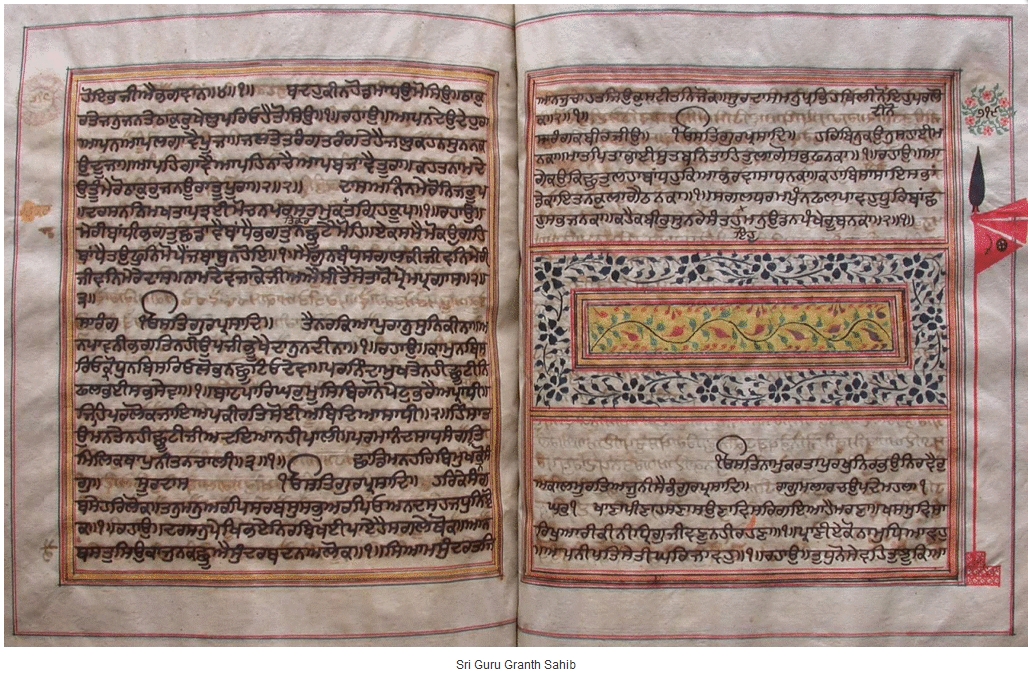
Panjab Cultural Association are proud to announce our preservation project of an endangered Guru Granth Sahib. This valuable Sikh treasure was discovered by a leading academic who works with Panjab Cultural Associations and then the expert teams at the University took the great task of arranging to preserve this valuable treasure for posterity.
Unfortunately, the Guru Granth Sahib currently requires extensive conservation work in order to restore it, the binding has broken and there are ripped folios. We urgently need you to donate and volunteer your skills in order to restore the saroop and create and exhibition around it.
- This Guru Granth Sahib is one of the oldest saroops in the world.
- It is all written in hand and continuous (larivar).
- Like many other saroops in the UK it was taken in the Anglo-Sikh wars.
- The ink recipe is at the end of this Holy Guru Granth Sahib.
Other discoveries made from within this saroop will be disclosed in a forthcoming exhibition of this Guru Granth Granth Sahib once it has been restored and digitalised. We urge you to donate generously towards the restoration costs of this Granth {27,000 GBP} and 7,2500 GBP in order to digitise the saroop. Please visit our secure donation page to contribute towards this valuable seva.
A highly decorated manuscript, in the Kashmiri style, from 1775 AD. This folio shows the garland of musical measure, the rag mala, the closing section of the Guru Granth Sahib.
The New Walk Museum, Leicester as part of the “300 sal” (three hundred year) celebrations is facilitating a number of lectures focussing on the Guru Granth Sahib. The Museum is the only one in the country which has dedicated a Sikh exhibition to commemorate this auspicious occasion. The first in the series of these lectures to be undertaken was on Tuesday 14 October.
The lecture was undertaken by Kamalroop Singh, Phd candidate from Birmingham University. His lecture was initially intended to be a introduction on the Guru Granth Sahib but due to his knowledge on Sikh manuscripts he ventured into highly detailed descriptions of how the transmission of the Guru Granth Sahib had taken place.
The lecture commenced with an explanation of how and what “Ik Oankar" means, there was a detailed analysis of how these important words were the cornerstone of the Sikh scripture. Following this were many images of how the Guru Arjun Dev and Baba Buddha prepared the pothi sahib. The importance of Gurudwara Ramsar was also alluded to. A brief mention was made as to how the Guru Gadi (guruship) was given to the Guru Granth Sahib and how Nanded was the resting place of the Tenth Guru and the Guru Granth Sahib.
There were a number of manuscripts which were discussed including an early recension of the Guru Granth Sahib at Patna with the daskhat (signature) of Guru Gobind Singh, a rare manuscript from Damadama School, as well as the Kirtarpuri bir. A very interesting bir (manuscript) of the Guru Granth Sahib was also discussed which was given to a muslim pir (holy man), Buddhu Shah, the sons of which were sacrificed in battle to defend freedom.
The Guru Granth Sahib that was given to Pir Buddha Shah by Guru Gobind Singh.
The lecture was enhanced with video footage of the parkash ceremony, that is, how the Guru Granth Sahib ceremoniously opened every morning at the Harimandir Sahib or Golden Temple. Further footage was shown as to how the Guru Granth Sahib is laid to rest after recitation. A very interesting and personal take of the lecture was the description and serenity of the Ber Baba Buddha Ji (tree) where Kamalroop Singh explained how the birds within the trees looked like bulbs on a tree, hence the notion that the effect of Gurbani within the precincts of the Harimandir was spiritual to humans and animals alike.
The participants asked some very interesting questions including: Why was Mira Bhai bani included in some recensions of the Guru Granth Sahib? Why compositions from woman were not included in the Guru Granth Sahib? Kamalroop gave some very informed answers to these questions. One question that was asked was related to the sanctity of the Guru Granth Sahib, the scholar befittingly explained how the Guru Granth Sahib was the sole guru of the Sikhs and how it was the only scripture in world religions to have been written and compiled by the founders of the religion.
In the end, the lecture turned more into a general discussion related as to the how the Sikh scripture are important to the Sikhs, this was good for the public as it then became more informal and allowed several points to be raised about how lectures of this type should be facilitated within the country.
The next lecture will be focusing specifically on Guru Granth Sahib Manuscripts and how literacy for the Sikhs was promoted: Leicester City Council website
More information on the Sikh exhibition: See PHN story
Unless otherwise mentioned, all events take place at New Walk Museum & Art Gallery. For bookings, telephone 0116 225 4920.
Sikh Objects Explored
Wednesday 1st October
2.00pm – 3.00pm
Handling session of Sikh objects relating to the exhibition ‘The Living Guru – The Holy Sikh Scripture’. Sharing your stories
about these types of objects is always welcomed. Places limited, advanced booking advised. Not suitable for children. £1.70 for activities.
Sikh Exhibition Tour & Visit to Gurdwara
Saturday 4th October, 22nd November & 6th December
2.00pm – 4.00pm
Take a guided tour of the ‘The Living Guru – the Holy Sikh Scripture’ exhibition and visit a local Gurdwara (Sikh temple). Less suitable for younger children. £2.70 for activities.
New Walk Museum Talk: The Living Guru (part 1)
Tuesday 14th October, 12.30pm – 1.30pm
Introduction to the exhibition, ‘The Living Guru – The Holy Sikh Scripture’, with Kamalroop Singh, specialist on Sikh religion, PhD candidate, University of Birmingham. All are welcome, though the talk is less suitable for children. £2.70 for activities.
Sikh Instruments
Sunday 19th October
11.00am – 4.00pm
Try out different Indian instruments similar to those on display in the exhibition ‘The Living Guru – The Holy Sikh Scripture’ under guidance of professional musicians.
£1.70 for activities.
Celebrating Sikh Heritage
Saturday 1st November
11.00am - 1.00pm, 1.30pm - 4.30pm
Enjoy the richness of Sikh heritage including workshops and demonstrations such as turban tying, making chapattis and sampling Punjabi food. Suitable for all ages.
New Walk Museum Talk: The Living Guru (part 2)
Tuesday 4th November
12.30pm – 1.30pm
Sikh manuscripts and the development of literacy. With Gurinder Mann,
Leicester - based Sikh historian. All are welcome, though the talk is less suitable for children. £2.70 for activities.
New Walk Museum Talk: The Living Guru (part 3)
Tuesday 18th November
12.30pm – 1.30pm
The evolution of Sikh music. With Professor Surinder Singh, Saranda musician and Director and founder of the Raj Academy. All are welcome, though the talk is less suitable for children. £2.70 for activities.
Saturday 29th November, 5.00pm – 7.00pm
A concert of ancient Sikh music played on forgotten instruments. Musicians of the Raj Academy, London, will play and explain this musical tradition. Less suitable for young children. £4.00 for activities.
New Walk Museum Talk: The Living Guru (part 4)
Tuesday 2nd December, 12.30pm – 1.30pm
The role of the Holy Sikh Scripture in Sikh life-ceremonies and festivals. With Harleen Kaur, secondary science teacher and Mandeep S. Sehmi, PhD candidate at the University of Birmingham. All are welcome, though the talk is less suitable for children. £2.70 for activities
Kamalroop Singh, University of Birmingham and Shironmani Panth Khalsa Akali Buddha Dal Panjva Takht,‘A discussion of the scriptures of Guru Gobind Singh in relation to Sikh history and praxis’