Showing posts with label Gurinder Singh Mann. Show all posts

Monday, 25 January 2016

The Guru’s warrior scripture by Kamalroop Singh and Gurinder Singh Mann

The scripture known as the Dasam Granth Sahib or the ‘Scripture of the Tenth King,’ has traditionally been attributed to Guru Gobind Singh. It was composed in a volatile period to inspire the Sikh warriors in the battle against the Moghuls, and many of the compositions were written for the rituals related to the preparation for war (Shastra puja) and for the battlefield. The verses generally consist of battle scenes and equate weapons with God, where the sword symbolises the victory of good over evil. War, according to the Tenth Guru, should only be a righteous war or dharam yudh, and it is true that the Sikhs throughout their history have been noted for their exemplary ethics in warfare. Guru Gobind Singh writes in his epic letter known as the Zafarnama that it is only justified to ‘raise the sword once all means have been exhausted.’ The compositions were written in mostly Braj Bhasha, and some smaller compositions are composed in Persian and Punjabi. In contrast to the primary Sikh scripture, the Adi Guru Granth Sahib, which is written in Shanti ras or verses that inspire peace, the Dasam Granth has a heroic strain of expression or Vir ras.


dasam granth 1
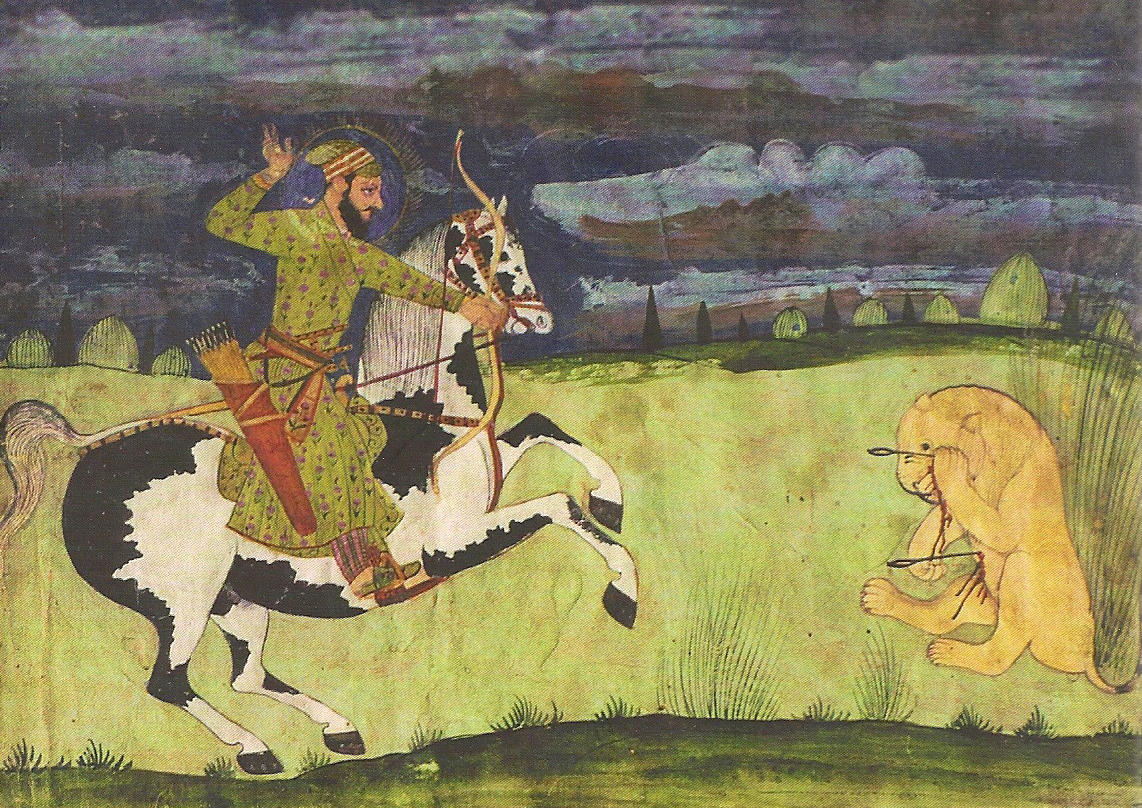
A portrait of the Tenth Guru hunting from the ‘Anandpuri’ recension of Dasam Granth from 1696 AD by Joginder Singh Ahluwalia. Used with permission.
In recent times, the Dasam Granth has been of much interest and volatile debate. This debate has its roots during colonialism in the Sikh reformist movement, known as the Singh Sabha. The most controversial and volatile discussion is that of the authorship, which is the most polemic and opinionated argu­ment that one could ever experience. Rather than being concerned with this issue of authorship, it is better that discussions are based on primary sources, like manuscripts and relics.
There is an intrinsic relationship of the scripture to the maryada (traditions), which includes the shastras (weapons), the Takhts (thrones of polity), and the warriors known as the Akali Nihangs. It is important to consider the historical context that the scripture was written in, and its link with battlefield sciences of the period. Whilst the primary scripture is now predominantly seen in Gurdwaras or Sikh temples across the world, during colonialism the Dasam Granth was removed from its ceremonial role, and it actual contents have been overshadowed by the rhetoric of reformist movements.


dasam granth 2
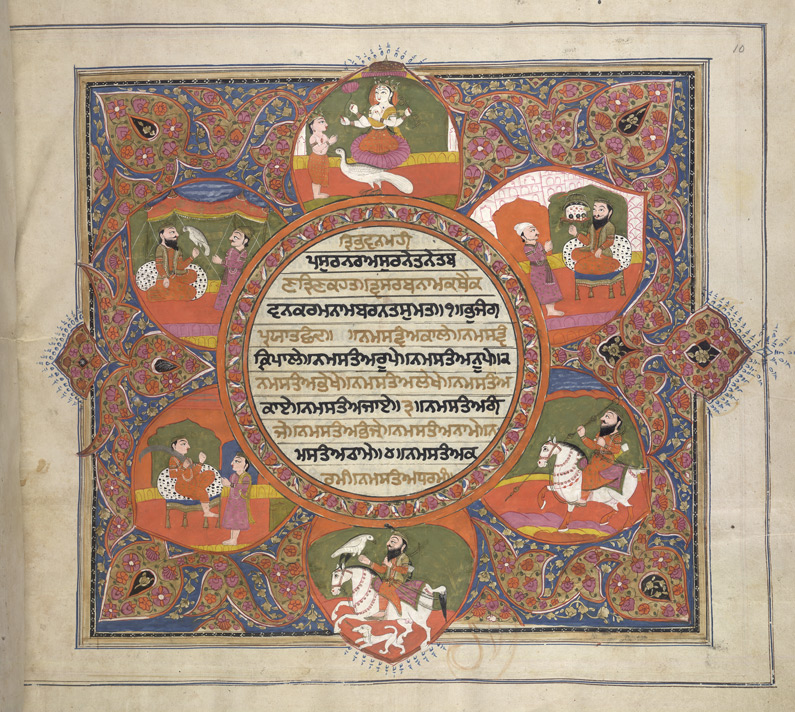
Illuminated frontispiece of the Dasam Granth, a scripture of Sikhism containing many of the texts attributed to tenth Sikh guru, Guru Gobind Singh (1666­1708). (Image credit: “Dasam Granth” from Or. 6298. © The British Library Board, used with permission.)
- See more at: http://blog.oup.com/2016/01/gurus-warrior-scripture/#sthash.eSGXVZPh.dpuf

Thursday, 17 January 2013

Dasam Granth Q and A presented to Sikh Saints and Scholars

When I arrived in India I thought it was only right to pay my respects at Bhabaur Sahib where it is likely that the Dasam Granth was bound when the Charitropakhyan Sahib was completed.
Gurdwara Bhabaur Sahib where the Charitropakhyan was completed with the Chaupai Sahib
Close up to the board which gives the Colophon from the Dasam Granth Sahib.
After this point I visited Baba Surjit Singh in Patiala and presented him a copy of the book.


A number of years ago  Sant Parmjit Singh of the Sant Samaj asked me to write book in Punjabi and he would add to it, but unfortunately he passed away. So instead I gave a copy to his brother Soami Harnam Singh ji, pictured below. The task of writing the book into Punjabi has now been taken up by the Buddha Dal. Copies of the book were also give to Sant Baba Gian Singh pictured further below, Dr Baljinder Kaur of Bhasha Vibhag, Dr Rupinder Singh, as well as many other scholars.


Sant Parmjit Singh who is sadly missed by the Sangat.
Sant Baba Giana Singh student of Buddha Dal and Dam Dami Taksal. A master of Sikh scripture and sword. At 105 years old he is doing very well. He even went to jail with Mahatma Gandhi!
After presenting the book to Dr Baljinder Kaur of Bhasha Vibhag, she kindly presented us a copy of her book.
Ranjit Singh Advocate saying some kind words about my research.

Wednesday, 16 January 2013

A presentation on the Dasam Granth given at Lund University in 2008


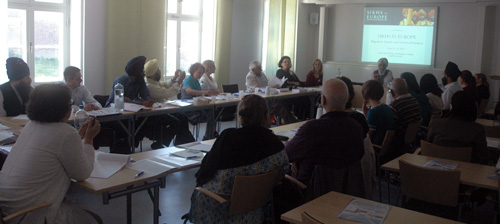
An Exploratory Workshop on "The Sikhs in Europe. History, Religion and Representation" was held at Lund University, 13-14 June 2008. The conference was funded by the Bank of Sweden Tercentenary Foundation, the Swedish Research Council, the Swedish Council for Working Life and Social Research and the Wenner-Gren Foundation. The invited speakers included Prof. Shinder Thandi from Coventry University, UK, who talked about "Migration and History of the Sikhs in Europe"; and Prof. David Omissi, University of Hull, UK, who talked about "Indian Soldiers in Europe, 1914-1918". The entire workshop was public. On the second day, discussions were held regarding possibilities for future European collaborative research projects on Sikhs in Europe. More information.
At the end of the workshop, the participants decided to establish the network Sikhs-in-Europe for the purpose of developing closer academic cooperation between students and researchers with a common interest in the Sikhs and Sikhism in Europe.
The creation of the network Sikh-in-Europe reflects a growing academic interest in the European Sikh and Punjabi diasporas. An extensive migration from the Punjab – the north-western state of India and the “ homeland" of the Sikhs - in the twentieth century resulted in Sikh settlements in different parts of the world. This development attracted the scholarly attention to the Sikh religion and Sikh diasporas, especially in English-speaking countries. New patterns of migration, settlements, representations and transnational networks of the Sikhs in more recent decades have made scholars aware of the importance to undertake research studies of the Sikhs in different European contexts and the need to create academic collaborations across disciplinary and national borders. As the first step in this direction, the network Sikhs-in-Europe is an initiative to create cooperation between scholars who come from a wide range of disciplines and are affiliated to different universities in Europe and beyond. In July 2008, a new web site was established by the network, titled Sikhs-in-Europe It contains a lot of useful information about conferences etc. Go to the web site.
sikhconflund10 (40K)
A full-scale three-day conference on "Sikhs in Europe. Migration, Identity and Translocal Practices" was then held at Lund University, 16–18 June 2010. The aim was to gather leading scholars in the multidisciplinary field of Sikh studies and discuss current research projects focusing on patterns of migration, identity formations, self-representations, transmission of traditions and trans-local practices among Sikhs in different parts of Europe.
gurindersingh (7K)sikhconf3 (10K)
While two conference days were dedicated to presentation and peer-review of papers by the members of the academic network Sikhs-in-Europe, the third conference day was a workshop for Ph.D. students affiliated to European universities, organised by Dr. Laura Hirvi, University of Jyväskylä, Finland.
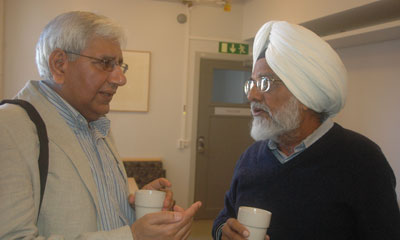
Knut and KristinaGurinder S MannThe conference was again convened by Dr. Kristina Myrvold, Lund University. Here seen with Prof. Knut Jacobsen, University of Bergen (photo to the right).
The keynote lecture on 16 June was given by Prof. Gurinder Singh Mann, Centre for Sikh and Punjabi Studies, University of Californa at Santa Barbara, USA (photo to the left). He spoke about "Guru Nanak and the Sikh Religion: Some Reflections", and focused on the classic 1968 monograph "Guru Nanak and the Sikh Religion" by Prof. W H McLeod, University of Otago, New Zealand.
Other participants to the conference included Dr. Doris Jakobsh, University of Waterloo, Ontario, who gave a SASNET lecture in 2004 on "Sikhs, Colonization, Gender and Ritual" (more information); Prof. Eleanor Nesbitt, University of Warwick, Coventry, UK (also Reviews Editor for the Journal of Punjab Studies); and PhD candidate Kathryn Dominique Lum, who completed Lund University’s Masters programme in Asian Studies in 2007, and is now based at the European University Institute in San Domenico di Fiesole, Italy, working on a doctoral dissertation project related to the Ravidassia Community and Identity(ies) in Catalonia, Spain (more information).
sikhconf2 (16K)
sikhconf1 (49K)Participants at the 2010 conference in Lund: Shinder Thandi, Coventry University, UK; and Swarn Singh Kahlon, independent researcher from Chandigarh, India. Other participants: Kaveri Harriss, University of Sussex, UK; and Kamalroop Singh, University of Birmingham, UK


Conference report: Sikhs in Europe 2010
Written by Administrator
The first report of the conference "Sikhs in Europe: Migration, Identity and Translocal Practices" that was held at the Centre for Theology and Religious Studies, Lund University, on June 16 to 18 is now available at the Swedish South Asian Studies Network (SASNET).
Sikhs-in Europe is an independent and interdisciplinary academic network for students, teachers and scholars conducting studies of and research in all areas related to the Sikh history, religion and culture in Europe. The forum was created in 2008 and is managed by a collaborative group of scholars from different European universities.

The aims of the network are:
  •   To promote and establish academic cooperation and exchange between students, teachers and scholars from various disciplines who share the interest in Sikh Studies.
  •   To assist students and scholars by facilitating access to information about research projects and publications on the Sikhs in Europe.
  •   To provide updated information about academic events and activities related to the Sikh Diasporas.
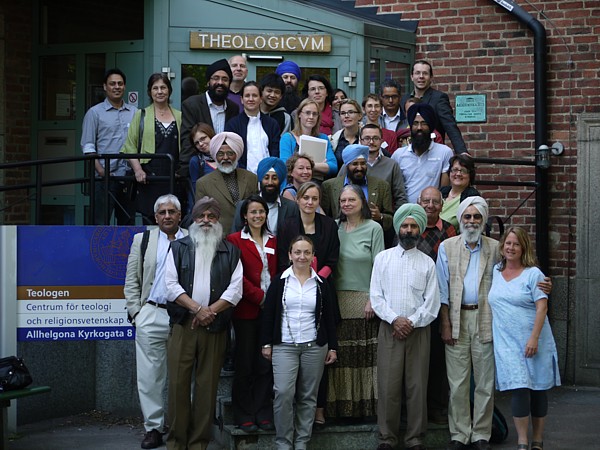
group photo 2010 (110K)
Participants of the conference "Sikhs in Europe: Migration, Identity and Translocal Practices" held at Lund University on June 16 to 18, 2010.
Photo: Martin Lund.

Monday, 5 November 2012

Book Review of Sri Dasam Granth Sahib: Questions and Answers by Harjeet Singh Grewal


Sri Dasam Granth Sahib: questions and answers
Gurinder Singh Mann & Kamalroop Singh, Archimedes Press, 2011100 pp., £8.99, ISBN 978-0-9568435-0-0

In Sri Dasam Granth Sahib: questions and answers, the authors Gurinder Singh Mann and Kamalroop Singh  seek to redress recent debates about not only the importance and relevancy of the Sri Dasam Granth Sahib  (SDGS) for the Sikh tradition, but they also entertain questions regarding its authenticity, authorship, as well  as the historical and contemporary position of this text for Sikh thought. The perspective of the book is  scholarly and grass roots, as both authors have spent time as active members of the Sikh community as well  as having pursued scholarly research of the SDGS at the postgraduate level. This volume appears to be  released as a needed intervention into the current controversy surrounding the SDGS as well as a brief  installment along the way to a larger, more comprehensive work discussing the SDGS. With a view to  describing some of the less well-understood intricacies of the SDGS, it is a welcome addition to the limited  number of English language volumes discussing the SDGS.
This work is meant to be a resource for students interested in Sikh Studies. As the title suggests, the book is  structured around common questions that many Sikhs today have regarding the SDGS. Indeed, as the  preface to the book reveals, some of the 50 questions posed in this work have been asked and addressed by  the authors previously on the following three websites: (1) www.sridasamgranth.com (2)  www.patshahi10.org and (3) www.dasam.info. However, while it may seem that the volume is merely repeating information that has appeared in other media, the volume is important as the authors have not only revised their original answers, but also because the volume collates these answers giving readers a singular reference for questions regarding the SDGS. The book is well researched, using manuscript sources from the seventeenth and eighteenth centuries as well as cross-referencing issues that arise from debates about the SDGS with passages from the primary Sikh scripture, Sri Guru Granth Sahib.The authors also use illustrations from these manuscripts as well as pictures of seventeenth-and eighteenth-century Sikh relics in order to support the view that they are purporting.
The work begins with a general description of the SDGS, it addresses the question of authorship – a point which is revisited at disparate points in the text, the SDGS’s central theme of the oneness of god is discussed, the SDGS’s engagement with moral themes,and finally a brief synopsis of the SDGS’s contents is provided for those unfamiliar with its outline. One of the central claims of the authors is that the SDGS gives a reinterpretation or, perhaps even, a correction to ‘Hindu’ mythology in order to foreground the moral core of the SDGS. This is done by Guru Gobind Singh not in order to link Sikhs to ‘Hinduism’, but rather to subvert the very idea that ‘myths’ can be claimed by a single historical bloc such as the term ‘Hindu’ suggests. The authors claim that,through the usage of vir ras, the SDGS puts forward a Sikh panthic worldview which exhorts people to take the Khalsa path and become karma yogi or a proactive renunciate. In donning such a stance, it compels people toward becoming true sovereign ethical beings – although this point is not expanded upon. The SDGS is not simple a secondary scripture, nor is it in opposition to Sikhi; more to the point, it is ‘complimentary’ with regard to the central message of Sri Guru Granth Sahib. Furthermore, commentary and understanding of the SDGS require a broader education in and knowledge of Sri Guru Granth Sahib and other Sikh scripture. In taking such a stance, the authors seek to correct the misplaced presumption that Sikhs had a singular scripture and restore the position of a scriptural constellation which fuels the Sikh political–spiritual vantage point.
From here the work considers the manuscript tradition as well as other early texts such as the various Rahitnamas. It is shown that these early works often engage with theSDGS, build upon it to develop a core group of ideals and, thereby, often assume the importance of the SDGS. Further on in the work, a discussion regarding the British Imperial perspective on the SDGS and its relation to the ‘Sikh Martial Spirit’ is provided as well as a description of the work done by the Sodhak Committee, which collated 32 manuscripts of the SDGS in 1895 and 1896. The central points from this committee’s deliberations are also given. These points include confirming that the entire SDGS was the work of Guru Gobind Singh, stating that the dates are verifiable and historical,Guru Gobind Singh used several pen-names throughout, and that some manuscripts contained unique content. The committee was central in providing a standardized text of the SDGS. The legacy of Singh Sabhia, Babu Teja Singh Bhashauria (1867–1933), is hereafter given as one of the central mechanisms through which the debate regarding the SDGS,but also sections of the Sri Guru Granth, begins. Teja Singh expressed his view that socalled spurious sections of these texts should be expunged and the remaining materialbe collated as a single scripture. Despite being excommunicated by not only the AkalTakht but also Takht Hazur Sahib, Takht Patna Sahib, and Takht Kesgarh Sahib between 1928 and 1929, Teja Singh’s legacy continues to fuel secular reformist sentiment regarding the Sikh scripture. The final series of questions deals with contemporary rites and sections of the Sikh panth which continue to uphold the position of the SDGS.
The very structure of Sri Dasam Granth Sahib: questions and answers, a question–answer format reminiscent of exegetical steeks and tikas, reveals one of the major limits of this work: its seemingly theological core. Despite trying to address the rationalist secular attacks from reformist Sikh critics and ‘Western’ scholars, the work itself relies upon the notion of a pre-existent theological core to the Sikh tradition which pervades what comes to resemble a Sikh Scriptural constellation. This is not to diminish the importance of the point that the authors are attempting to make, nor is it meant to takeaway from the very necessary corrective which they are engaging with regard to the rationalist monotheolingual perspective of Sikh scripture. It is merely to make the point that a more elaborate critical core to the argument may facilitate and strengthen the point being made. Beyond this point, the Sikh theological question–answer format can at times lead the work to read as disjoint, jarring, and sporadic. This structural problem often requires a degree of cross-referencing between different questions – an endeavor quickly frustrated by the lack of a comprehensive index.
While meant for students of Sikh Studies, this work assumes some degree of familiarity with Sikh textual materials, history, and theological debates. As such, the intricacies of the position being taking regarding the validity and centrality of the SDGS maybe missed by the uninitiated. Therefore, it is better suited to Sikhs or scholars with an active interest in textual and theological questions. The position of the authors is that the Dasam Granth is a Sikh scripture; that it is central to the development of Sikh rites and ceremonies; that the evolution and continued adherence to the Khalsa ideals of Guru Gobind Singh depend upon the SDGS; and, lastly, that the work in its entirety was originally authored by the tenth and last Sikh Guru. As such, the argument made is that when questioning the validity of the SDGS, a kind of symbolic violence is being done to the entire Sikh tradition. To extrapolate somewhat from the position taken by the authors in this work, one may claim that the debates around the SDGS are centered upon the position of Sikhi as a religion within the confines of a hegemonic secular discourse.In short, the ideals expressed and the reinterpretations of central ‘Hindu myths’in the SDGS need to be put in doubt if the discourse of secularism is to dominate. Thus,this work attempts to correct some of the invasive machinations by secular scholars of religion. As a brief installment of a larger more comprehensive volume discussing the SDGS, Sri Dasam Granth Sahib: questions and answers, raises some important points and provides a necessary corrective to the ongoing machinations of a minority of people regarding the position of the SDGS in the Sikh tradition and textual corpus. However,due to some of the structural and critical constraints outlined, the main argument’s dialectic rings hollow and leaves one anticipating the larger work referenced in the text’s preface.
Harjeet Singh Grewal
PhD Candidate
University of Michigan© 2012
Sikh Formations: Religion, Culture,Theory:  16 Oct 2012.